


Written by
Tim Collins
Published on
4 August 2026
Most senders think of their email list as an asset. Sometimes it is a liability, and the difference comes down to how clean it is.
Every invalid, dead or risky address sitting in your list is a small cost waiting to be paid. You pay it in bounces, in wasted send credits, and most expensively in sender reputation. Email validation is the practice of finding those addresses and dealing with them before they do damage, and for anyone sending in real volume it is not optional.
Why bounce rate matters more than you think
When you send to an address that no longer exists, the receiving server rejects it. That is a hard bounce, and inbox providers watch your bounce rate closely as a signal of how well you look after your list.
The accepted ceiling is low. Keep hard bounces under about two per cent and you are fine. Push past it and providers start to treat your mail with suspicion, because a high bounce rate is exactly what a spammer working from a scraped list looks like. The result is that your good, deliverable contacts start seeing your email land in spam, punished for the company they keep.
This is the trap: a dirty list does not just waste the sends to bad addresses, it degrades delivery to the good ones too.
You cannot see the bad addresses by eye
The hard part is that a list full of problems looks exactly like a healthy one in a spreadsheet. The addresses are all correctly formatted. Nothing is obviously wrong. The rot is invisible until you send, and by then the bounce has already been recorded against you.
Several kinds of address cause trouble:
- Invalid or undeliverable addresses that no longer exist or never did.
- Risky addresses, such as role accounts and catch-alls, that are more likely to bounce or complain.
- Spam traps, which are addresses that exist purely to catch senders who did not get proper permission. Hitting one is a serious reputation event, and you will never know you did it.
Purchased lists, scraped addresses and lists that have been sitting untouched for a year or two are the usual sources. The older the data, the worse it gets, because real people change jobs and abandon addresses constantly.
How email validation works
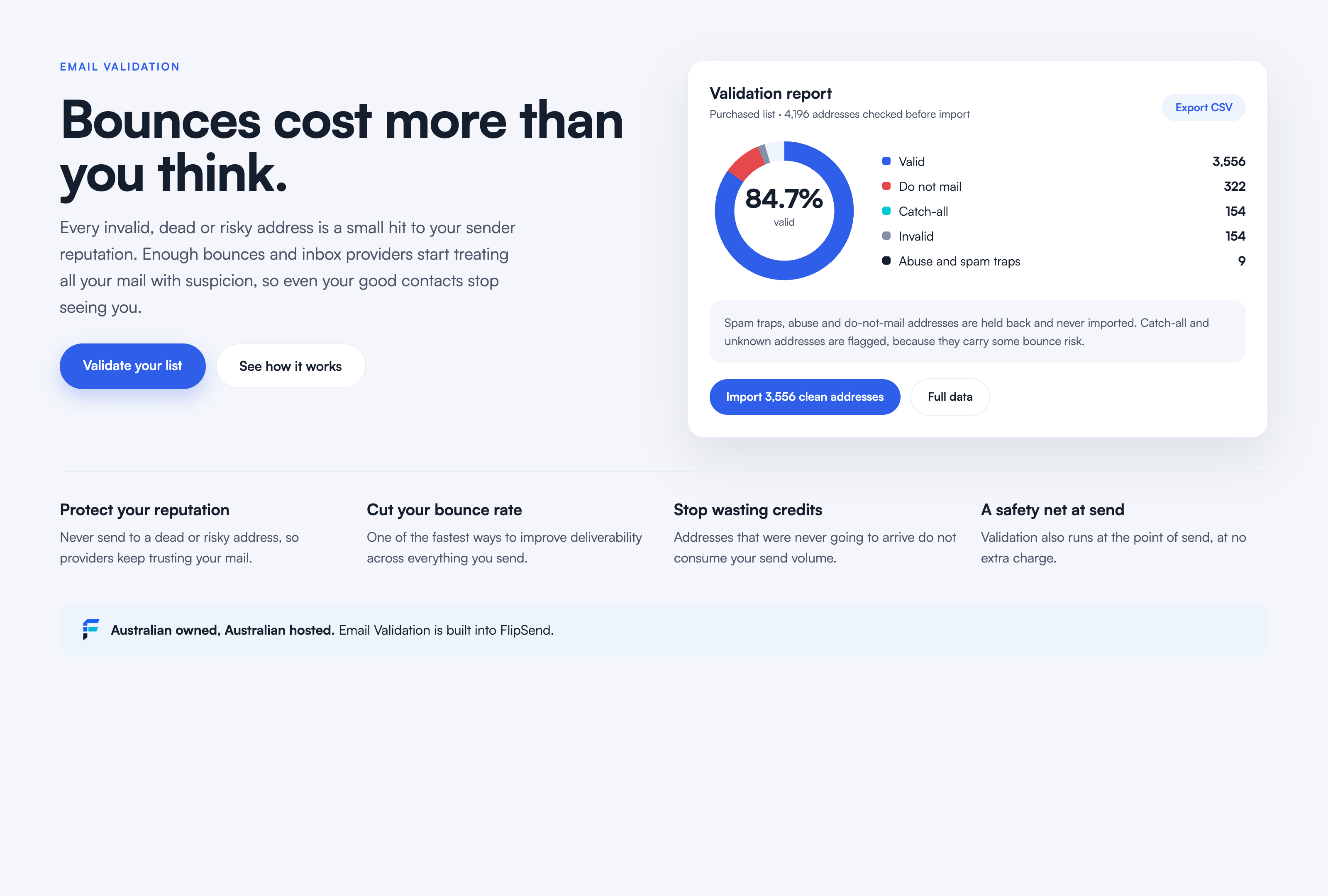
Email validation checks each address against a series of tests before you ever send to it. It confirms the domain exists and can receive mail, checks the mailbox itself where possible, and flags the risky and trap-like addresses that should be held back.
In FlipSend this runs in two places. You can validate a list up front, either as you import it or on a list you already hold, so the dangerous addresses are separated out before your first send. And validation also runs at the point of send at no extra charge, as a safety net that catches anything that slipped through. The result is that your campaigns go only to addresses that were actually going to arrive.
When to validate
There are a few moments when validation earns its keep straight away.
Validate any list you did not build yourself the moment it arrives, before it touches your sending domain. Validate an old in-house list before you reactivate it, especially if it has been more than six months since you last sent. And build validation into your import routine so new data is checked as it comes in, rather than discovered as a bounce later.
If you have already been sending to a questionable list and your bounce rate has crept up, validation is also the first step in cleaning up: remove the invalid and risky addresses, and give the providers a reason to trust you again.
It is a compliance question too, not just a deliverability one
In Australia there is a second reason to care. Under the Spam Act 2003 you need consent to send marketing email, and purchased or scraped lists give you neither consent nor clean data. The compliance risk and the deliverability risk point the same way, which is convenient, because cleaning your list and sending only to people who agreed to hear from you is the same piece of work.
Keep your list an asset
A smaller, clean, validated list will outperform a larger dirty one on every measure that matters, including total revenue. Removing dead weight feels like going backwards, but it is the fastest way to protect the reputation that gets your email seen at all. Once your list is clean, inbox placement testing is the natural next step to confirm the mail is actually landing.
FlipSend includes email validation as standard, alongside inbox placement testing, authentication setup and suppression handling, all of it run and hosted in Australia. If you want a read on the state of your current list, we will check it with you. It takes about ten minutes and there is nothing to sign.
FlipSend by Flipside Digital. Email, SMS and fax from one platform, built and hosted in Australia.