


Written by
Tim Collins
Published on
11 August 2026
There is a number in every email platform that quietly misleads people, and it is the delivery rate.
You send a campaign, the report comes back at ninety-nine point something per cent delivered, and it feels like the job is done. It is not. Delivered only means a mail server accepted the message. It tells you nothing about which folder it landed in, and a server is perfectly entitled to accept your email and then file it straight into spam.
This is why so many senders are convinced their email is working when it is not. The dashboard is green, the delivery rate is high, and the replies never come. If that sounds familiar, the tool you are missing is inbox placement testing.
Delivery rate and inbox placement are not the same thing
It helps to separate the two clearly.
Delivery rate answers one question: did a mail server accept the message. That is all. It counts anything that was not hard-bounced as delivered, including everything routed to spam or the promotions tab.
Inbox placement answers the question you actually care about: of the mail that was accepted, how much reached the inbox where someone will see it. This is the number that predicts replies, clicks and sales, and it is the number a delivery report cannot give you.
A campaign can be one hundred per cent delivered and still have most of it in spam. The two figures are measuring different things, and only one of them tells you whether your email is working.
What inbox placement testing actually does
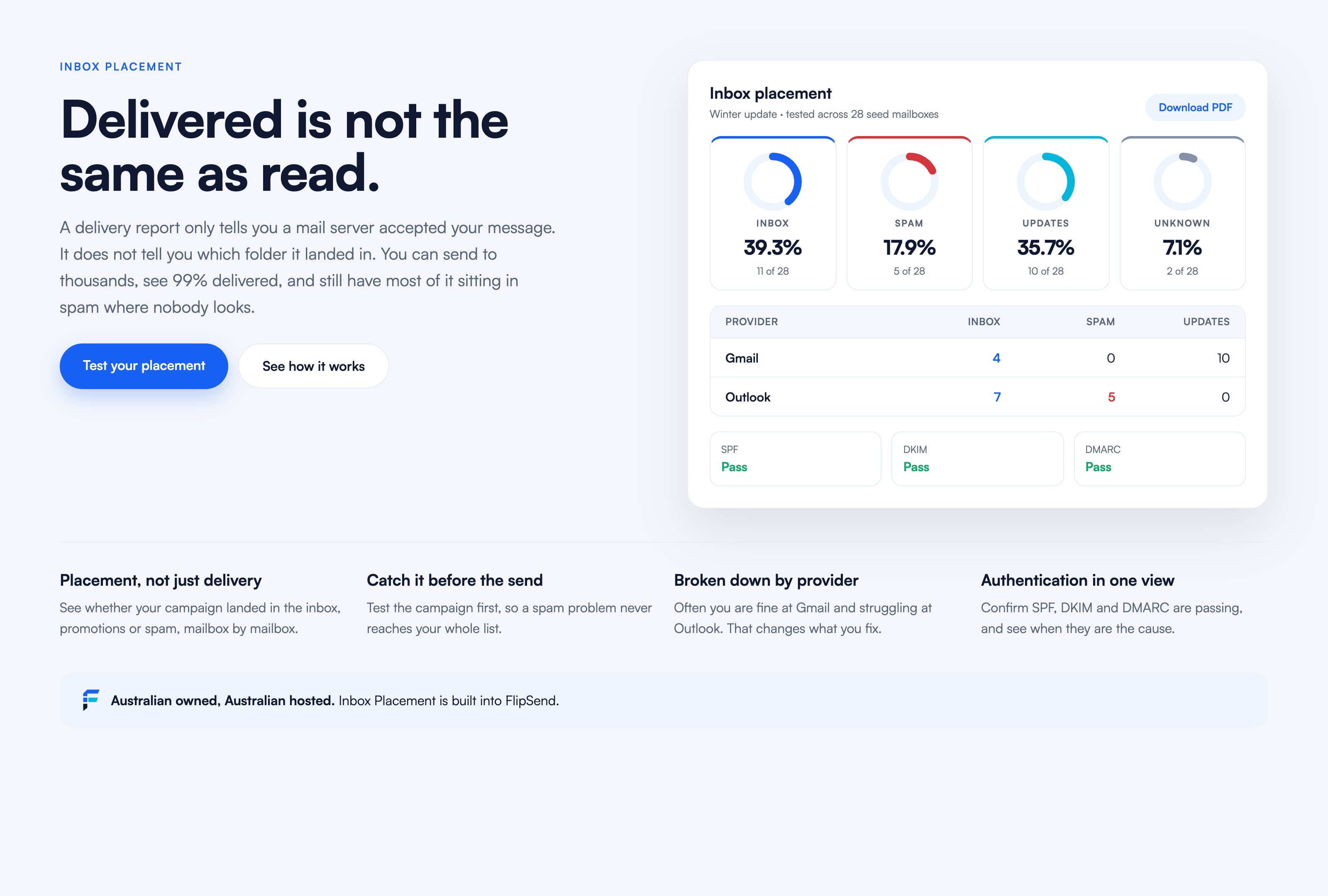
Inbox placement testing works by sending your campaign to a panel of seed addresses spread across the major mailbox providers, then checking where each copy lands. The result is a breakdown by provider: how much reached the inbox, how much went to promotions or other tabs, and how much was filtered to spam.
In FlipSend this is built in. When you run an inbox placement test, you get a clear read on your placement across Gmail, Outlook and the other providers your contacts actually use, alongside a check of your authentication records. That last part matters, because a failing SPF, DKIM or DMARC setup is one of the most common reasons good email ends up in spam, and seeing it in the same view tells you whether authentication is your problem before you go looking anywhere else.
Why a per-provider breakdown changes what you do
The most useful thing about inbox placement testing is that it splits the result by provider, and providers do not agree with each other.
It is common to be landing cleanly at Gmail while struggling at Outlook, or the reverse. That single fact changes your next move. If you are fine at Gmail and failing at Outlook, the issue is usually something specific to how Microsoft assesses your domain, not a blanket reputation problem. Without the per-provider view you would be guessing, and most likely making broad changes that do not address the actual gap.
Test before you send, not after
The real value of placement testing is timing. Run it before you send to your whole list, and a spam problem becomes something you catch and fix while it only affects a handful of seed addresses. Find out afterwards, and the damage is already done: a poorly placed campaign to your full list feeds negative signals back to the providers and drags your reputation down, which makes the next campaign harder still.
Getting into the habit of a quick placement check before a significant send is one of the cheapest pieces of insurance in email marketing.
Where this fits with the rest of deliverability
Inbox placement testing tells you where you stand. It does not, on its own, fix a reputation problem, and it works best alongside the other habits that keep mail landing: clean authentication, a validated list, sensible sending volumes, and easy unsubscribes. If you want the fuller picture of why mail goes to spam in the first place, we covered that in detail in our guide to why your emails go to spam.
What placement testing gives you is honesty. Instead of trusting a delivery number that was never designed to answer the question, you can see where your email actually lands and act on it.
See where your email lands
FlipSend includes inbox placement testing as standard, alongside authentication checks, list validation and everything else that keeps your mail in the inbox. And like everything we run, it stays in Australia, which matters if you work in healthcare, government, education or anywhere the Privacy Act 1988 shapes what you can do with customer data.
If you are not sure where your current sending stands, we will run a check with you and tell you plainly. It takes about ten minutes and there is nothing to sign.
FlipSend by Flipside Digital. Email, SMS and fax from one platform, built and hosted in Australia.