


Written by
Tim Collins
Published on
23 July 2026
There is a moment that catches a lot of senders out. You set up a shiny new domain, get your SPF, DKIM and DMARC in order, load your list, and send your first campaign. The delivery report looks fine, and then nothing happens. No opens worth mentioning, no replies, no clicks. What went wrong is not your content or your list. It is that you sent from a domain nobody had ever seen before, and to a mailbox provider an unknown sender that suddenly emails thousands of people looks exactly like a spammer.
This is the problem domain warming solves, and it is why we warm every sending domain for 30 days before your first real campaign goes out.
Why a cold domain gets filtered
Mailbox providers like Gmail and Outlook decide where your email lands based on reputation, and reputation is built on history. A domain that has never sent mail has no history at all, so the provider has nothing to trust. Send a small, steady trickle and it looks like a normal person or business getting started. Send a large blast on day one and it looks like abuse, because that is exactly the pattern spammers follow: register a domain, burn it on one big send, move on.
So the provider does the safe thing. It filters you. Your carefully written campaign goes to spam or promotions, your recipients never see it, and the low engagement that follows tells the provider it was right to be cautious. That first bad impression then makes the next campaign harder, and a domain can dig itself into a hole it never climbs out of.
What warming actually does
Warming builds the history a provider needs, on purpose and in a controlled way. Rather than launch you straight into full volume, we start small and increase send volume gradually over the 30 days, so the provider watches a natural, rising pattern instead of a sudden spike.
The warming mail is not sent into a void. It goes to a network of seed mailboxes that open it, reply to it, and move it out of spam if it lands there. Those actions, opening, replying, marking as not spam, are the strongest positive signals a mailbox provider looks for. They are what tells Gmail and Outlook that real people want this sender's mail, which is precisely the reputation you need before your own audience ever receives a message.
Measured, not assumed
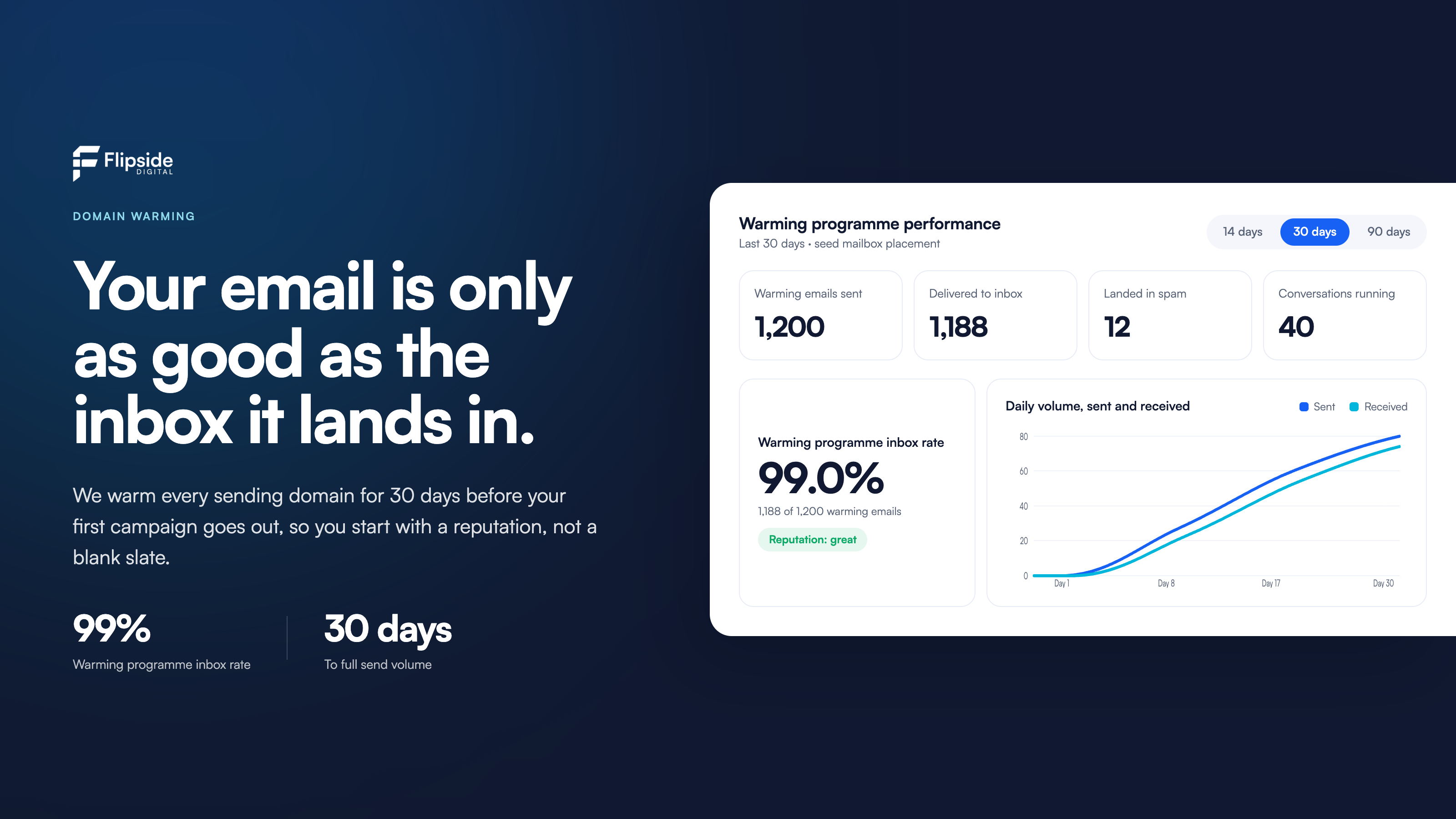
The part that matters most is that warming is measured, not taken on faith. Because the warming mail goes to seed mailboxes, we can see where it actually lands each day, inbox or spam, and track the inbox rate as it climbs.
A healthy programme looks like the numbers on the dashboard above: well over a thousand warming emails sent across the month, the overwhelming majority reaching the inbox, and only a small handful filtered to spam early on before the reputation settles. By the end of the ramp you are sitting near a 99 per cent inbox rate on the seed panel, which is the evidence that your domain is trusted. You are not guessing that warming worked. You can see it.
Warming is not a one-time trick
It helps to think of reputation as something you maintain rather than something you switch on once. Warming gets a new domain to a trusted starting point, but the way you send afterwards is what keeps it there. Clean lists, consistent volume and genuine engagement hold the reputation you built. Sudden spikes, stale lists and high complaint rates erode it, warm domain or not.
That is why warming sits alongside the rest of the deliverability tools rather than replacing them. Validate your lists so you are not mailing dead addresses, test inbox placement before big sends, and keep your sending steady. Warming gives you the running start, and good habits keep you moving.
Start in the inbox
The whole point of warming is timing. Do it before your first campaign and a cold, untrusted domain becomes a warm, credible one while it only affects seed addresses. Skip it and your real audience becomes the experiment, at the exact moment a poor first impression does the most damage.
We build this into FlipSend so you never have to think about it. Every sending domain is warmed for 30 days, monitored daily, and handed to you ready to send. You start in the inbox instead of the spam folder, which is the only place a campaign can actually do its job.
If you want the fuller picture behind all this, we have since written a four-part series on domain reputation: what it actually is, who scores it, what it costs when it slips, and why we leave warming switched on rather than treating it as a one-off setup task.